How the 'DD Act' transformed disability rights and community services

Lois Curtis sometimes worried she'd somehow been to blame for what happened to her. During a 2014 interview, she apologized for what she may have done to be institutionalized at Georgia Regional Hospital, where she had lived — frequently sedated and isolated — starting when she was 11 years old and extending to adulthood.
Curtis hadn’t done anything wrong, the interviewer reminded her. And neither had the thousands of other individuals with intellectual or developmental disabilities confined to prison-like conditions through decades of U.S. history.
At 27, Curtis and co-plaintiff Elaine Wilson won their lawsuit against the state of Georgia for their right to freedom, in a 1999 landmark Supreme Court ruling that paved the way for more equitable treatment of individuals with disabilities.
The justices found “segregation of the disabled constitutes discrimination.” Passage of the Developmental Disabilities Assistance and Bill of Rights Act of 2000, also known as the DD Act, followed just a year later.
The DD Act — and Curtis' pursuit of justice — have rippled across the country to transform policy, funding and research at the University of Kansas to support people with intellectual and developmental disabilities.
From institutions to awareness
The DD Act has its origins in legislation passed in the 1960s that expanded civil rights and services to individuals with disabilities, including intellectual and developmental disabilities (IDD).
In the 1960s, state-run institutions were the first and often only option for individuals with disabilities, and doctors encouraged parents to turn over disabled infants and children to the state for care. In 1967, at the height of institutionalization, 194,650 individuals lived in such facilities.
However, concern about the living conditions at state institutions for people with disabilities grew as part of the broader civil rights movement in the United States.
In 1965, Sen. Robert F. Kennedy made an unannounced visit to one state-run facility, Willowbrook State School in Staten Island, N.Y. He was appalled by the conditions and later described children "living in filth and dirt, their clothing in rags, in rooms less comfortable and cheerful than the cages in which we put animals in a zoo."
Expanding rights and support
In part as a response to the condition of children living in Willowbrook, laws changed. The DD Act expanded in 1975 to include four essential components:
- University Centers for Excellence in Developmental Disabilities (UCEDD) — a national network of university-based centers that focus on improving the lives of people with IDD and their families, established in 1963. The University of Kansas is home to one of the 68 UCEDDs across the nation.
- Developmental Disabilities Councils — federally funded, self-governing organizations charged with identifying the most pressing needs of people with developmental disabilities in their state or agency. At least 60% of a council’s membership must consist of individuals with developmental disabilities or their family members.
- Protection and Advocacy System — designed to protect and advocate for the rights of people with developmental disabilities and to pursue legal, administrative, and other remedies to accomplish these ends.
- Projects of National Significance — a federally funded grant program that addresses national needs and responds to emerging or urgent areas of concern that, in 1975, was authorized to award support for projects related to intellectual and developmental disabilities. The three projects include the State of the States in Intellectual and Developmental Disabilities, a longitudinal study based at the University of Kansas that studies how federal funds are spent on services for people with IDD across the United States. The project compiles data to help inform policies, legal actions, care decisions, and more.

Also in 1975, New York Gov. Hugh Carey took action toward closing Willowbrook and housing its residents outside of an institutional setting into group home environments. It was one of his first official acts of office.
The last residents of Willowbrook left in 1987.
A new model for independence
Since the 1970s, home and community-based services (HCBS) gradually replaced institutional care. In 1981, waivers under Medicaid allowed for care in residential and community settings. By 1989, states were allocating more money to HCBS than institutional services.
Programs across the U.S. were enacted or expanded following the Supreme Court’s Olmstead ruling in 1999 and the DD Act of 2000. States were required to provide the least restrictive environment for individuals with disabilities, ensuring they are not unnecessarily segregated in institutions.
As an alternative to institutions, home and community-based services offer several benefits — including lower costs. The federal Centers for Medicare & Medicaid Services (PDF) reported in 2021 that HCBS waiver program services cost 62% less than institutional care. People with IDD benefit directly, with access to individualized care, engagement in their communities, a sense of autonomy, and greater quality of life.
Services and support may include help with cooking, making and keeping appointments, assisting with medication, transportation to and from work, managing finances or personal care. In fiscal year 2023, HCBS supported 950,347 individuals with IDD across the country.
While the majority of HCBS Medicaid waivers are for individuals with IDD, waivers also support HCBS for aging adults with health conditions. Nearly 4.5 million people depend on Medicaid-funded HCBS across the U.S., the KFF reported. About 20%, or nearly 1.5 million people, were aged 65 or older, according to federal data (PDF).
The waivers allow states to use federal Medicaid funding to provide essential services — personal care, homebound shopping, home nursing care, medication set up, housework, assistive technology and more — to avoid institutional care.
Funding and workforce shortages in disability services
Access to these services, however, continues to be a problem as states control their own waiver programs, including the number of people served and how much funding is allocated. The Kaiser Family Foundation (KFF) in 2024 reported about 710,000 people are on wait lists for HCBS across about 40 U.S states, with more than a half a million waiting specifically for IDD waivers. Some states, such as Kansas, have waitlists for services that are several years long.
One challenge to getting people off the wait lists is a continued lack of HCBS workers. According to the report from KFF, 48 states reporting shortages among five or more provider types, including direct support professionals, personal care attendants, nursing staff, home health aides, case managers, community-based mental health providers, and therapists specializing in occupational, physical or speech therapy.
The White House announced in March 2025 plans to massively restructure the Department of Health and Human Services (HHS). Proposals at that time included reducing HHS workforce by as much as 25% and eliminating the Administration for Community Living (ACL), which houses federal efforts to ensure older adults and people with disabilities are able to maintain their health within their own communities.
HHS Secretary Robert F. Kennedy Jr. said the administration’s core functions could be distributed among other organizations within the government. However, researchers and experts have expressed concern that this would threaten access to data to inform public policy, research, training, services and support — and are also concerned what this shift in priorities would ultimately means for the millions of individuals with IDD and their families.
“Every American with or without disabilities deserves a chance to live with dignity,” said Shea Tanis, associate research professor at the Kansas University Center on Disabilities and primary investigator for the State of the States in IDD. “Gutting this funding would send the opposite message.”
Tanis noted that many of the positive changes for people with IDD have been greatly influenced by communities of people with disabilities. Those include Self Advocates Becoming Empowered (SABE). The organization’s 1995 statement about institutions said, “We believe that all institutions, both private and public should be closed. All people regardless of severity of their disabilities should live in the community with the support they need.”
Lois Curtis’ vision for dignity and independence
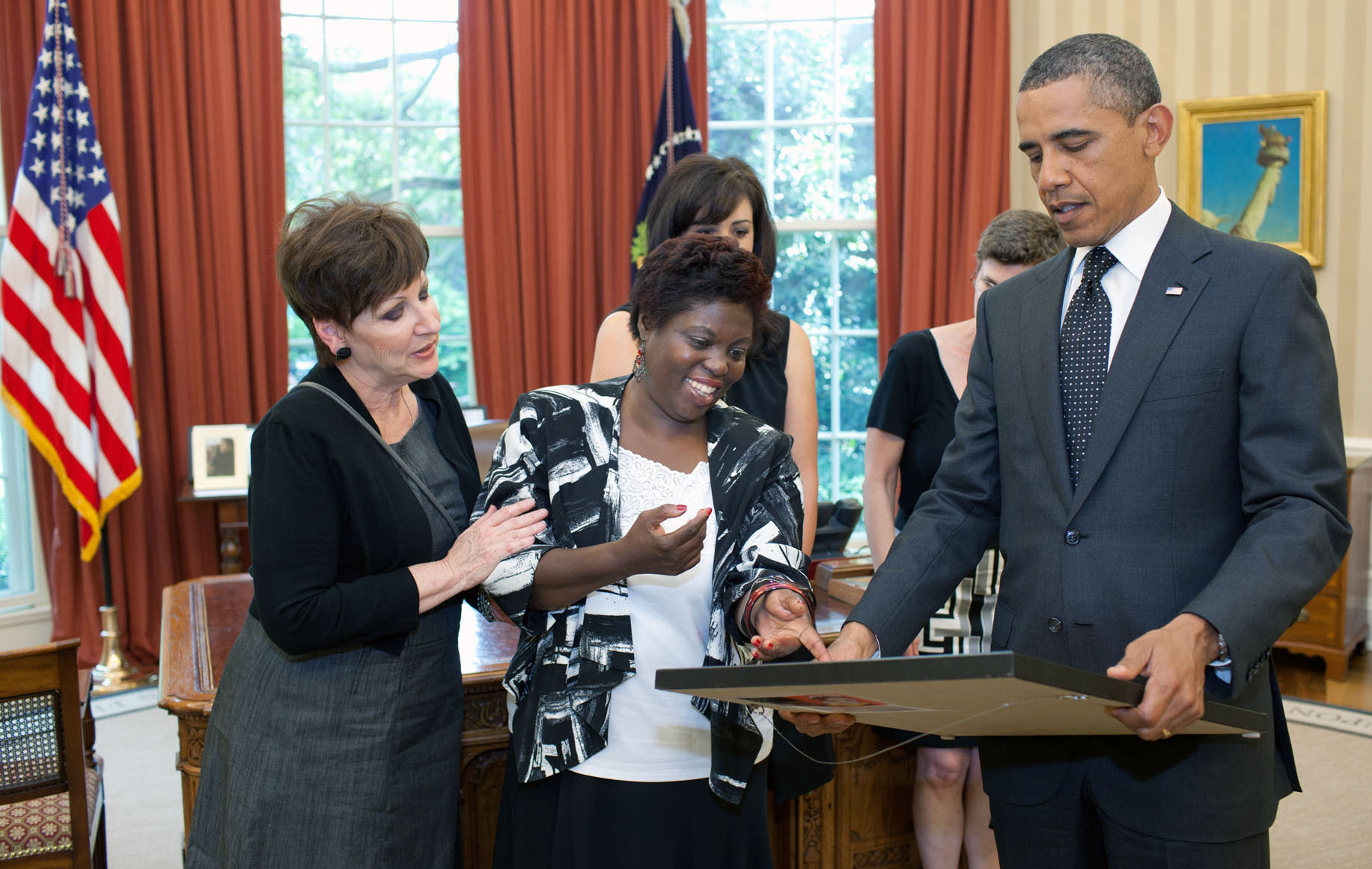
Lois Curtis has continued to work as an advocate for disability rights. Outside of the institution, she saw more options open up for her. She became an artist and gifted one of her pieces to then-President Barack Obama when she met him in 2011.
Years later, Curtis reflected on her life and shared hopes for others like her.
“I hope they live long lives and have their own place,” she said. “I hope they make money. I hope they learn every day. I hope they meet new people, celebrate their birthdays, write letters, clean up, go to friends’ houses and drink coffee. I hope they have a good breakfast every day, call people on the phone, feel safe.”